Showing posts with label culture. Show all posts

Monday, 18 October 2010

Rencong, the traditional dagger sharp weapons from Aceh

Rencong (Bahasa Aceh: reuncong) is a traditional Acehnese dagger sharp weapons, the Indonesian island of Sumatra, the shape resembles the letter "L". Rencong including a dagger in a different category with a knife or sword.

The shape and usage
Rencong similar way as with a dagger. Rencong long blade can vary from 10 cm to 50 cm. Matau blade can be curved like a dagger, but in many rencong, can also be straight like a sword. Rencong inserted into the sheath knife made of wood, ivory, horn, or sometimes silver or gold metal. In nature, rencong inserted between the belt in front of the user's abdomen.

In the customary law
Dagger rencong empire, made of gold and ivory sheath with engraved blade holy Quran verses.
Rencong have levels; to the king or sultan sheath usually made of ivory and the blade of gold and berukirkan sekutip verses from the Quran the holy religion of Islam. While other rencong rencong-usually made of buffalo horn or wood as a sheath, and brass or white metal as a dagger.

As confidence in the Javanese kris, traditional Acehnese community connects with the mystical power of weapons Rencong. Rencong still used and worn as a fashion attribute in the traditional ceremonies of Aceh. The Acehnese people believe that the form of rencong basmalah represent the symbol of the religious beliefs of Islam.

Rencong so popular in the people of Aceh so that Aceh is also known as the "Tanah Rencong (Land of Rencong)"

source:
http://id.wikipedia.org/wiki/Rencong

Friday, 15 October 2010

Keris, ethnic weapon from Javanese ancient tradition

The most famous ethnic weapon or heirloom for Javanese people is Keris (dagger). In the ancient time, a man is not considered as a real man if he has no keris. The keris is highly valued, treated and respected with special care. This weapon is usually inherited from fore fathers. According to Javanese ancient tradition, especially in the court families, a father was obliged to give to his adult son at least a keris.

Keris is a stabbing weapon that is known in Nusantara or Indonesia, including Malay Peninsula and the southern Philippines. The use of the keris itself scattered in the area dwellers who have affected the culture of Srivijaya-Majapahit, such as Java, Madura, Nusa Tenggara, Sumatra, Kalimantan coast, part of Sulawesi, the Malay Peninsula, southern Thailand and southern Philippines (Mindanao). Kris form Mindanao do not have much in common with other areas of the keris, although also a stabbing weapon. The keris of Indonesia has been listed in UNESCO as a World Cultural Heritage Non-human material.

In general, keris is divided to two important parts, the blade (Wilah) and the scabbard (Warangka), to protect the blade.
A keris is considered 'good' if it has perfect physical characteristics and at the same time contains good and strong spiritual power.

Besides being used as a weapon, a dagger is also often considered to have supernatural powers. These weapons are often mentioned in many traditional legends, such as empu Gandring's Keris in legend of Ken Arok and Ken Dedes.

The procedure for the use of different dagger in each region. In areas such as Javanese and Sundanese, a dagger was placed in the rear waist peacetime but is placed in front in wartime. Meanwhile, in Sumatra, Borneo, Malaysia, Brunei and the Philippines, a dagger was placed in front.


The history

Originally Keris that we know today is still not explained very well. Temple reliefs in Java such as Borobudur and Prambanan (9th century) more show knights with Indian-style weapons. Relief that clearly reflected this weapon are in:
- Bahal Temple (11th century AD) the royal heritage Penai/Pane in North Sumatra that are part of the Srivijaya empire

- Penataran Temple (13th century AD), relics of the Majapahit kingdom in Blitar, East Java.

Although we can not be sure when the real dagger was first formed but given the dagger in several temple reliefs on where in the 9th century there has been no relief that clearly indicates the keris, dagger-shaped still India, was in the 11th century was clearly illustrated it can be concluded that the keris has take a unique shape around the 9th century to 11th century AD

Keris of Buddhist and the
influence of Indian-China culture

Early kingdoms of Indonesia strongly influenced by Buddhist and Hindu culture. Temples in Central Java is the main source of cultural era. The surprise was the least use of dagger or something similar to it. Relief at Borobudur did not show a similar dagger.

From the archaeological discovery of many experts who agree that the proto-dagger-shaped knife blade straight with thick and wide. One of these is a kris dagger type Knaud family owned, obtained from Sri Paku Alam V. Keris is relief on the surface that contains the epic Ramayana and there are years of Java, 1264 (1342 AD), although there are doubts about the milestone.

The influence of Chinese culture may enter through the Dong Son culture (Vietnam), which is a link between Chinese culture and the Malay world. There keris sajen which has a shape similar to a dagger hilt human Dong Son.

The "Modern"
Keris

Keris which we now know is the result of a long evolutionary process. Modern keris known today is a unique dagger awl. many who believe that the dagger obtain forms at the time of Majapahit (14th century) and new Mataram Sultanate (17th century-18) but the reliefs of the temple bahal Pane royal heritage, part of the Srivijaya empire, in North Sumatra Portibi show on 10-11th century.

The form of keris as we know it today has found its form observer and collector dagger more often classified as ancient and newer keris (Javanese: nem-Neman).
Ancient Keris created before the 19th century, making use of ores and raw materials derived from natural sources and meteorites (because there is no metal ore smelting plants), so that the metal that is used still contain many types of other alloys, such as iron ore containing titanium, cobalt, silver, tin, nickel, copper etc..

Newer Keris (after the 19th century) usually only use materials of iron, steel and nickel from the smelting of iron ore, or scrap metal (per vehicle spare parts, iron bridges, railway iron, etc.) that the average is manufactured, so that purity guaranteed or likely to contain very few metals other types.

Suppose research Haryono Arumbinang, Sudyartomo and Budi Santosa (BATAN Yogyakarta nuclear scholar) in the era of 1990, showed that a keris with tough Tuban, kitchen Tilam Upih and prestige of Rice Wutah turned out to contain iron (Fe), arsenic (arsenic) and Titanium (Ti)
, according to the researchers that the keris is "an ancient dagger," for the element titanium metal, new metal is found as an element of self in about 1940, and metals which exceed the hardness of steel but much lighter than steel, widely used as a means of modern transportation (plane aircraft, spacecraft) or a rocket, so at that time the technology has not been present in Indonesia. Titanium many meteorites found on rock and iron sand usually comes from the South Coast region as well as Sulawesi. Of the 14 kris studied, the average alloy contains many other species such as cromium, Stanum, stibinium, silver, copper and zinc, as much as 13 kris contains titanium and only one dagger that contain nickel.

Newer Keris can be immediately known because of its metal content of the type of empu (kris craftsmen) to buy their raw materials in iron stores, such as iron, nickel, brass etc.. They do not use raw materials from iron ore (eg taken from mining) or stone meteorite, so it does not need to be analyzed with radioactive isotopes. So if there is suspected as a result kris engineering, or new kris kris-looking ancient, the research will be easy to express it.


The process of the making of the blade

The process of the making of the blade in the old days may last one year only for one keris. The keris maker is called an Empu. Only the respectable Empus could make a high quality keris, physically and spiritually. Empu has to do some spiritual deeds to prepare a keris, like fasting, not sleeping for several days and nights, meditation, etc.
In Principle, a keris is a personal sacred weapon, it is made by an Empu, in accordance with the wish of the consumer.

The manufacturing of keris is complicated, for short as the following :
- At workshop with good fire plate to case the row materials such as 5 kg iron plate, measuring; 4 cm wide, 2 cm thick, 15 cm long; 50 gr of nickel and 0,5 kg of steel.
- The iron is heated until it become smaller, it forges again and again.
- The 5 kg iron become 2 kg forged iron.
- The nickel inserted in between the forged iron, smolder them, forged them carefully to produce the desired 'pamor' or surface pattern.
- Afterward the steel sheet, together with above forged iron and nickel, smolder and forge again.

- In this stage the keris should be made Keris Lurus (a straight keris) or Keris Luk (keris with curves). The keris should be formed in accordance to the blue print, using several tools such as; rough fine, triangular files, grindstone and chisels.

- Afterwards the keris should be heated but not smoldered and than plated, to make the keris more durable. After it has been plated, it should be soaked in a mix solution of sulfur, lemon juice and salt. The keris is ready and its weight is about 0,4 kg.

The Physical Characteristic of Keris

There are some characteristic of keris
  1. Keris Lurus (straight Keris) and Keris Luk (curved keris)
  2. Dapur
    Dapur or shape is the keris specific form or type and identified by particular combination of parts and curved (luk). The meaning of dapur is based on certain standard which is called Pakem Dapur Keris. The names of dapur among other :
    • Sangga Buwono
    • Jangkung Mangkurat
    • Pasopati
    • Tilam Upih
    • Sengkelat
    • Jalak Nyucup Madu
    • Etc.
  3. Tangguh
    Tangguh is the estimated era of keris making. It is linked with prominent kingdoms, such as ;
    • Tangguh Kahuripan of XI AD
    • Tangguh Singasari of XII AD
    • Tangguh Pajajaran of XIII AD
    • Tangguh Majapahit of XIV AD
    • Tangguh Mataram of XIV - XVI AD
    • Tangguh Kartosuro
    • Tangguh Surokarto
    • Tangguh Yogyakarta
    • Etc.
  4. Pamor
    Surface pattern of a keris blade, the design has not been carved, it appears as a result of forging technique of different metals.
    Some pamor's name are :
    • Ilining Warih
    • Wos Wutah
    • Lintang Kemukus
    • Udan Mas
    • Mlati Sumebar
The Physical characteristic of Keris, also symbolizing its mission.
  1. Dapur : Jalak Ngucup Madu (jalak is a starling, a kind of bird; ngucup is drink; madu is honey). The wish is clear, the owner of the keris should live in prosperity.
  2. Pamor : Udan Mas (udan is rain; mas is gold). The keris has a mission to help its owner to have an abundant wealth.
  3. A. Keris Lurus or Straight Keris, symbolizing self-confidence, strong mentality.
    B. Keris Luk or Keris with Curved
    Luk 3 : symbolizing a success to achieve some wishes.
    Luk 5 : to be loved by other people
    Luk 7 : dignity.
    Luk 9 : dignity, charismatic and leadership.
    Luk 11 : to achieve high position
    Luk 13 : peaceful and stability of live.
The magical power of Keris

Believe it or not, despite its physical characteristic, keris contain a spiritual mission.The original spiritual power is the wishes of the Empu, the maker. While preparing and making a keris, the Empu, in the holy state, solemnly pray to God , the keris should contain spiritual wishes as requested by the Empu or the consumer.

It depends who is going to use the keris, the mission should be different, for instance, for the kings, begawans (priest), generals, high ranking officials, farmers, traders, fishermen, workers, soldiers, etc. So, it could be easy to understand that a keris which good for king , may be not good for a trader.

The Additional and/or Other Spiritual Power of Keris. The keris could be filled with spiritual beings, unseen by ordinary people, such as a genie, (jin or qodam) in order to protect or to help the keris owner.

Source:
http://www.joglosemar.co.id/
http://id.wikipedia.org/wiki/Keris


Saturday, 25 September 2010

How does Islam arrive to Nusantara?

The first introduction of Indonesia's population to Islam

In the year 30 Hijri or 651 AD, only about 20 years ago of the death of the Prophet Muhammad, the Caliph Uthman ibn Affan RA send a delegation to China to introduce Daula Muslims, who have long standing.
In a journey that took four years, the delegates turned out to Uthman had stopped at the Islands of the archipelago. Several years later, exactly the year AD 674, Umayyad Dynasty has established trade base on the west coast of Sumatra. This is the first introduction of Indonesia's population to Islam. Since then the sailors and Muslim merchants continued to arrive, century after century. They buy local produce from the land of green this while preaching.

First Islamic kingdom in Indonesia

Gradually, the indigenous population began to embrace Islam, although not yet on a large scale.
Aceh, the westernmost region of the Islands archipelago, is the first to accept Islam. Even in Aceh, first Islamic kingdom in Indonesia was established, namely Pasai. News from Marcopolo mentioned that at the time of sojourn in Pasai year 692 AH / 1292 AD, were many Arabs who spread Islam. Similarly, news of Ibn Battuthah, nomadic Muslims from the Maghreb., Which when dropped in Aceh in 746 AH / 1345 AD wrote that in Aceh have been scattered schools of Shafi'i. The oldest relic of the Muslims who are found in Indonesia located in Gresik, East Java. Form of Islamic tomb complex, in which one of them is the tomb of a Muslim woman named Fatima bint Maimun. Numbers written on his tomb in 475 AH / 1082 AD, ie at the time of the Kingdom of Singasari. It is estimated that these tombs are not from the natives, but the tomb of Arab traders.

Islam came to Southeast Asia by way of peace, not with a sword, not to seize political power

Until the 8th century H / 14 AD, there is no indigenous population
embraced Islam en masse. New in the 9th century H / 14 AD, the indigenous population embraced Islam en masse. The historians argue that Islam entered the archipelago population on a large scale in the century was due at that time the Muslims already have a significant political force. That is marked by the establishment of several Islamic kingdoms such as the Kingdom of patterned Aceh Darussalam, Malacca, Demak, Cirebon, and Ternate. The rulers of these kingdoms of mixed blood, descendants of the kings of the indigenous pre-Islamic and Arab immigrants. The rapid Islamization of the 14th century and 15 M, among others, are also caused by the decline of power and influence of the kingdoms of the Hindu / Buddhist in the archipelago such as Majapahit, Srivijaya and Sundanese. Thomas Arnold in The Preaching of Islam says that the arrival of Islam is not as conquerors as well as the Portuguese and Spanish. Islam came to Southeast Asia by way of peace, not with a sword, not to seize political power. Islam entered the archipelago in a way that really show it as RAHMATAN LIL'ALAMIN.

With the native population into Islam Nusantara and the establishment of Islamic governments in different parts of the archipelago, the trade with the Muslims from the center of the Islamic world became increasingly tight. The Arabs who migrated to the archipelago is also growing. The largest of which is derived from Hadramaut, Yemen. In the chronicle of Hadramawt, migration is even said to be the largest in the history of Hadramaut. But after the Christian European nations and the greedy master coming area-by area in the archipelago, the relationship with the center of the Islamic world as if disconnected. Especially in the 17th and 18th centuries AD. The reason, other than because the Muslim archipelago occupied by the resistance against colonialism, as well as various regulations created by the colonialist. Every time the invaders - notably the Netherlands - subjugate the Islamic kingdom in the archipelago, they would thrust the royal ban treaty whose contents are related to trade with the outside world except through them. So terputuslah Nusantara relations with the Islamic ummah of Muslims from other nations who had established hundreds of years. The colonialist desire to alienate Muslims archipelago with its roots, also visible from the assimilation policies that make them among the Arabs with the natives.

The arrival of the colonialists


Since the early arrival of the Europeans at the end of the 15th century AD to the fertile island is prosperous, is already seen their greedy nature to master.
Moreover, they found the fact that the population of these islands have embraced Islam, the religion of their enemies, so that the spirit of the Crusades was always carry around every time they beat a region. In their fight against Islam in collaboration with indigenous kingdoms that still adhered to Hindu / Buddhist. One example, to decide cruise lines of the Muslims, then having seized Malacca in 1511, the Portuguese cooperation with the Kingdom of Sunda Pajajaran to build a base in Sunda Kelapa. But the purpose of this Portuguese failed miserably after the combined forces of Islam from the north coast of Java along hand in hand to demolish them in 1527 AD Of this historic battle led by an Arab-blooded son of Aceh Gujarat, namely Al-Pasai Fadhilah Khan, better known by his title, Fathahillah. Before becoming an important man in the three Islamic kingdom of Java, namely Demak, Cirebon and Banten, Fathahillah had studied in Mecca. Even the participate defend Mecca of the Ottoman Turkish invasion.

The arrival of the colonialists on the one side has awakened the spirit of jihad of the Muslims archipelago, but on the other side make the deepening of belief in Islam is uneven. Only the pesantren (Islamic schools) who studied Islam, and even then usually limited to the Shafi'i school. While the majority Muslims, mixing faith with pre-Islamic traditions. Aristocratic circles close to the Dutch even have affected the European lifestyle. Conditions like this still happen at least until now. Apart from this, scholars Archipelago are the people who persevere against colonialism. Although many of them come from the congregation, but it is often among the congregation rose up against the invaders. And although in the end it was crushed any resistance with tactics devious, but history has recorded millions of martyrs who died in the archipelago a number of battles against the Dutch. Since the resistance of Islamic kingdoms in the 16th and 17th centuries such as Malacca (Malaysia), Sulu (Philippines), Pasai, Banten, Sunda Kelapa, Makassar, Ternate, until the resistance of the scholars in the 18th century such as the War of Cirebon (Bagus Rangin), Java War (Diponegoro), Padri War (Imam Bonjol), and the war in Aceh (Teuku Umar).

Source:
http://www.ummah.net/

Friday, 10 September 2010

Indonesia is The Lost Atlantis, isn't it ??

Location hypotheses of Atlantis

These are various proposed real-world settings for the island of Atlantis, (Ἀτλαντὶς νῆσος) a lost civilization mentioned in Plato's dialogues Timaeus and Critias, written about 360 B.C. In these dialogues, a character named Critias claims that an island called Atlantis was swallowed by the sea about 9,200 years previously. This story was passed down to him through his grandfather, Dropides who in turn got it from Solon, the famous Athenian lawmaker who translated it from the Egyptian language. Plato's dialogues locate the island in the Atlantic Pelagos “Atlantic Sea”,[1] "in front of" the Pillars of Hercules (Ηράκλειες Στήλες) and facing a district called modern Gades or Gadira (Gadiron), a location that many modern scholars associate with modern Gibraltar; however various locations have been proposed.

It also figures in the Celtic myths concerning Mererid, the sinful daughter of King Gradlon, whose scabrous conduct led to the sinking of the land of Ys. So, in the Americas (Bochica, etc.) and elsewhere.

If we read the Bible attentively, we note that it also speaks of two creations, exactly as Plato also tells of two different Atlantises (cf. Gen. 1 and 2). Moreover, the Bible also tells of two destructions of the world by the Deluge. These two different narratives are quaintly embroidered on each other in Gen. 6, and comprise the Elohist and the Jahvist accounts of the Flood, which relate two visibly different events.

The Bible Is Right After All

We see, then, that the tradition (or traditions) narrated by Plato exactly coincides with the Biblical lore. Moreover, as we said above, the two traditions also exactly agree with the prehistoric events observed in the geological and the archaeological records. And, when we trace the worldwide legends to their source, we always end up in India and Indonesia, the two Atlantises of legend, no matter where we start from.

In truth, continents don t sink. It is the sea that rises, flooding entire continents, as it did in Lemurian Atlantis and, to a great extent, in the Indus Valley, the site of the second Atlantis. Relativists will say that both events sea level rise and continental sinking are one and the same thing, at least from the point of view of the observers. But geologists will hotly debate the issue, and claim, as they have long done, that actual sunken continents are a geological impossibility. It is all a matter of perspective, of relativistic illusion. But the best ancient sources say, for instance that magnificent Hindu saga, the Mahabharata speak of sea level rising rather than of continents sinking.

The Elusive Sunken Continent Revealed

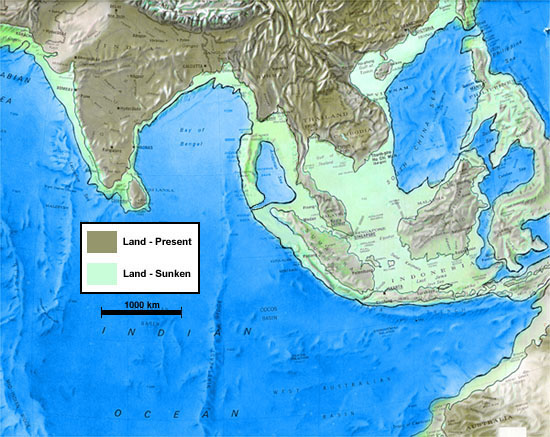
However, anyone who inspects a chart of the oceanic bottoms in the region of Indonesia such as the Ice Age Map of Indonesia shown in Fig. 1 below, will readily concede that the South China Sea encircled by Indonesia indeed formed a continent during the last glaciation, which ended some 11,600 years ago. This chart clearly shows the sunken continent of Lemurian Atlantis in Indonesia, as well as the extensive sunken strip of Indian Atlantis at the Indus Delta.

The map leaves no room for doubt about the reality of what we are affirming concerning Lemurian and Indian Atlantis, one almost wholly sunken, and the other sunken to a very considerable extension. We remark that this map in contrast to most others presenting proposed sites for Atlantis and/or Lemuria is purely scientific, rather than an invention of ours or of others. It is based on the detailed geophysical reconstruction of the seabottoms in the region in question, and portrays the areas of depth under 100 meters, which were obviously exposed during the Ice Age, when sea level dropped by that amount and even more.

Fig. 1 - Map of Atlantis During the Ice AgesIn fact, several strictly scientific, similar maps exist, and can be seen elsewhere, inclusive in the Internet. One of these maps, was published in the National Geographic Magazine (vol.174, no.4, Oct. 1988, pg. 446-7) and is reproduced, for comparison, in Fig. 2 below. It shows the world as it was some 18,000 years ago, at the peak of the last glaciation of the Pleistocene Ice Age. As can be seen, this map corresponds quite closely with ours, shown in Fig. 1.


Fig. 2 - Map by National Geographic Magazine of the Ancient World During the Ice Age (18,000 years ago)In particular, please note the huge chunk of land, of continental dimensions, to the south of Southeast Asia, and which became sunken when sea level rose, at the end of the Pleistocene. Another sizable piece of land in the Indus Delta, the site of the second Atlantis, also disappeared likewise, at that occasion. No other regions of the world display a similar event, including the Americas (not shown). The conclusion is that Atlantis, if Plato was in fact speaking truthfully, could only have been located in that region of the world.

As both maps above show, a huge extension of continental size prolonged Southeast Asia all the way down to Australia. This continental-sized land was indeed "larger than Asia [Minor] and Lybia [North Africa] put together", exactly as Plato affirms. It is seen to have been about two or three times larger than continental-sized India. It was also far larger than Australia, shown exagerated due to the peculiarities of the projection utilized.

The Lost Continent Finally Found, released on August 2005, is Prof. Arysio Santos' latest work.

The Indonesian Islands and the Malay Peninsula that we nowadays observe are the unsunken relicts of Lemurian Atlantis, the lofty volcanic mountains that became the volcanic islands of this region, the true site of Paradise in all ancient traditions. The sunken portion of continental extension now forms the muddy, shallow bottoms of the South China Sea.

The South China Sea north of Indonesia and Java Sea have been advocated as a site for Atlantis. Key to this argument that Sundaland was the location of Atlantis is that the Ocean of Atlantis refers to the ocean which encircles Eurasia and Africa, which was the historical understanding until the time of Christopher Columbus. Proponents of this idea claim that natives of Sundaland who fled the rising waters or volcanic explosions eventually had contact with Ancient Egyptians, who later passed the story onto Plato who gets some but not all of the details correct, including location and time period. The main advocate of this theory is the Brazilian professor of nuclear physics Arysio Nunes dos Santos.

During the Last Glacial Maximum, what is now known as the Sunda Shelf was the location of a large subaerial coastal plain that was part of Sundaland. During the Last Glacial Maximum, Sundaland extended northward from Indonesia to Borneo and northwestward to the coast of Southeast Asia. Sundaland is quite tectonically stable lacking any known prehistory of any significant, much less cataclysmic, tectonic subsidence. Numerous studies by petroleum and Quaternary geologists have found a complete lack of any evidence for any Neogene and Quaternary volcanic activity within the Sunda Shelf despite its proximity to Indonesia.

Detailed studies[100][101] of late glacial and postglacial sea level rise for this part of the Sunda Shelf demonstrates that the first significant submergence of Sundaland by rising sea level occurred between 14,000 and 15,000 years ago. Periods of abrupt rise in sea level submerged a significant part of Sundaland beneath the South China Sea between 13,000 and 14,000 years ago. Between 14,300 and 14,600 years ago, a period of 300 years, sea level rose 16m (62 feet). Between 12,000 and 13,000 years ago, the submergence of Sundaland by rising sea level was relatively minor. A final period of rapid flooding of Sundaland by the South China Sea occurred between 11,000 to 12,000 years ago. The submergence of Sundaland during this period was minor in extent relative to the area submerged between 13,000 and 14,000 years ago. Evidence for any significant or cataclysmic submergence of Sundaland as the result of tectonic processes is completely lacking.

Source:
  • http://www.atlan.org/
  • http://www.lost-civilizations.net/
  • http://en.wikipedia.org/wiki/Location_hypotheses_of_Atlantis